SPIN-D Flexible Funding Scheme
The second round of the SPIN-D Flexible Funding is now OPEN.
The SPIN-D Network+ is a collaborative effort to improve dementia care and prevention. We aim to bring together researchers, healthcare professionals, people with dementia, and their families to create innovative solutions. We have a Flexible Fund to support various activities, including:
- Scientific Calls: Funding for research projects focusing on dementia prevention and care.
- Sandpits: Workshops where experts can share ideas and co-create projects.
- Micro-challenges: Funding for small projects that explore innovative approaches to dementia.
- ECRs: Support for Early Career Researchers through internships and small grants. Find out more here: Register as an Early Career Researcher.
We will also offer training, mentorship, and knowledge exchange opportunities. We are committed to co-production and involving diverse communities. Contact us to express an interest in our flexible funding activities.
Flexible Funding 2026
Apply for funding to advance research and involve people with lived experience of dementia in reducing risk, delaying symptoms, and improving care.
The first call for SPIN-D flexible funding was opened in January 2025, closing at the end of March 2025. The call resulted in the network awarding funding to 11 projects, and further details about these projects can be found here. We are now pleased to launch our second round of flexible funding. Please see further information below about the funding available and how to apply.
Overview:
Call for applications: open from 22nd January to 31st March 2026.
SPIN-D is pleased to announce the second call for projects under the Flexible Funding initiative, aimed at Early Career Researchers. We wish to fund projects that will delve deeper into our understanding of dementia, or share findings from previous studies. We are interested in the role that different risk factors can play in determining whether people go on to develop dementia, and how symptoms advance. We are also interested in projects that test ways to reduce dementia risk and improve care and support for those living with dementia in their own homes.
Funding is available at two levels:
- ‘Inclusion in practice’ grants for small projects or events. Funding will be provided within an anticipated range of £400-£2,000, with an upper limit of £4,000 (at 80% fEC)
- Proof of Principle Research Project funding for carrying out a small pilot project, with funding up to £24,000 (at 80% fEC)
We also have a dedicated fund for enabling access to the PROTECT data source and other data sources to support dementia related data science research.
The Flexible Funding is awarded on a Full Economic Cost (fEC) basis, as per ESRC rules, and so the above figures are indicative of the total value of the project that would be provided by SPIN-D, with the recipient research organisation contributing 20%.
How Flexible Funding works:
Importance of involvement and coproduction
The SPIN-D network prioritises community-driven initiatives and research to deepen the understanding of dementia risk factors and enhance the lives of those affected by the condition. Importantly, these efforts should meaningfully involve individuals with relevant lived experience.
We want people with dementia and carers to be at the heart of your research.
Projects should include relevant involvement of charities, industry or government, and should demonstrate public and patient involvement and engagement through the proposed project. When designing their project plans, applicants should consider equity, diversity and inclusion, including how to include under-represented groups, such as minority ethnic groups and rural and coastal communities.
Funding will be awarded following a competitive process. Those projects supported in summer 2026 will be expected to start by 1st October 2026, once a funding agreement is completed. Projects then have until the end of September 2027 to complete the work. Information about the supported projects will be published on the SPIN-D website (see Awardees) and we will work with all recipients to embed the work that they are doing within the network.
Top Tips on writing an application:
Martin Orrell, Chair of the Proof of Principle Flexible Funding panel, discussed his top tips for writing an application at an early career researcher event in January 2026. This session was recorded and can be viewed here on the SPIN-D YouTube channel. Martin, who is also joined by Chris Fox, Georgina Charlesworth and Katrina Davis, talks about forming new collaborations and how to plan a new funding application.
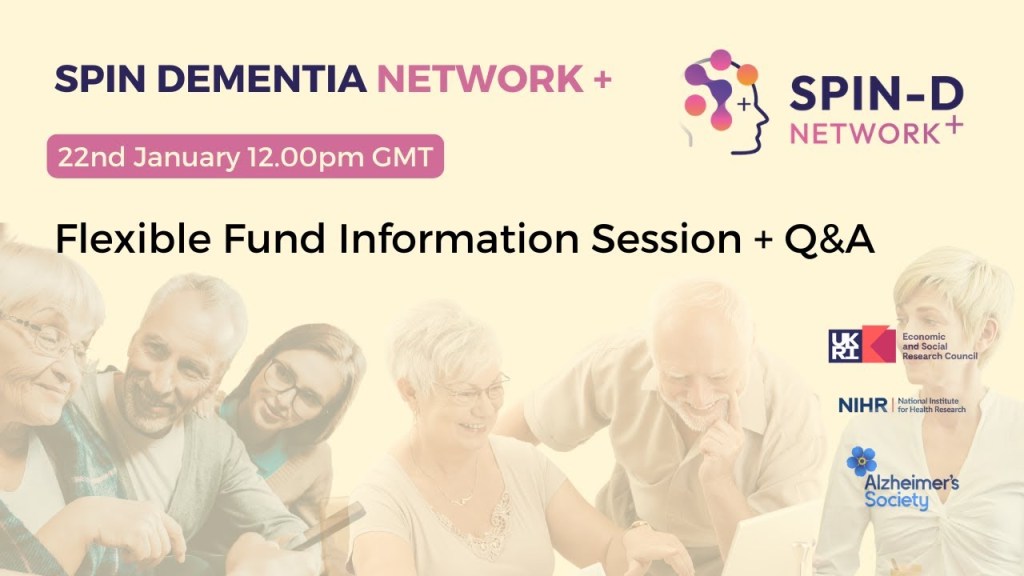
Webinar, SPIN-D Network + Flexible Fund – Information + Q&A:
A live-stream webinar about the funding call took place on Thursday 22nd January 2026. The recording from this event is available here (the recording from the 2025 webinar is available here). The webinar events were hosted by Dementia Researcher.
Coproduction and Involvement:
In this recorded conversation, Christine Wise, Bettina Wallace, Martin Robertson and Rachael Litherland give their insights into how to involve people with lived experience of dementia in a meaningful way in flexible funded project applications, and in project delivery.
Scheme at a glance: Inclusion in Practice
| We are looking for projects that facilitate collaboration in the community and with a focus on equity and diversity. | |
| Value Frequency of call Lead-applicant Co-applicants International co-applicants Industry Third sector co-applicants Duration Start by | £400-£2,000, with upper limit of £4,000 (80% fEC applied) Annually for 2 years An early career researcher based at a UK University/research organisation Accepted Accepted Accepted Required for this funding call 12 months 1st October 2026 |
Examples of outcomes from the ‘Inclusion in Practice’ call could include:
- Develop research involvement and co-production practice
- Inform the development of future funding bids
- Inform and support dissemination of research findings
Scheme at a glance: Proof of Principle Research Project
| This funding aims to pump-prime innovative high-quality, prevention studies that support SPIN-D themes and provide pilot or proof of concept work for external funding applications. | |
| Value Dedicated Data Access Funding Frequency of call Lead-applicant Co-applicants International co-applicants Industry & Third sector co-applicants Duration Start by | £12,000 – £24,000 (80% fEC applied) Up to £5,600 (80% fEC applied) Annually for 2 years An early career researcher based at a UK University/research organisation Accepted Accepted Accepted 12 months 1st October 2026 |
Examples of outcomes from the Proof of Principle Research Project call could include:
- Secondary research using previously published data
- Secondary analysis of existing large datasets including large research cohort datasets (e.g. PROTECT, 1947 Birth Cohort; ELSA, Understanding Society, BioBank) and datasets within NHS/service delivery organisations (e.g. primary care data/CPRD, hospital episode statistics), commercial organisations and voluntary and charitable organisations
- Pilots and proof-of-concept work which may include data from mobile and e-health applications
- Generation of new evidence including quantitative data (e.g. surveys and questionnaires) and qualitative data (e.g. interviews)
Data Access Funding
The fund for accessing data may be applied for as part of a Proof of Principle project, or as a stand alone application using the Proof of Principle form. If you are interested to know more about data sources and platforms that can be used for brain health and dementia research, you may like to watch this webinar hosted in collaboration with Dementia Researcher on 5th March 2026: Data for Brain Health and Dementia. As well as discussing different data sources, the webinar explored meaningful involvement of people with lived experience in data-driven research with Laura Gray. The event was designed for early-career researchers, clinicians, data scientists and others interested in dementia and brain health research.
How can I apply?
Please read the ‘Guidance information’ before applying. To apply please complete the application form below and submit the form as a PDF to the email address provided on the form by the deadline.
The Guidance information is available here.

 spindementianet.org