SPIN-Dementia Network Plus Flexible Fund Guidance
- SPIN-Dementia Network Plus Flexible Fund Guidance
- Key Dates
- Funding Calls and Awarding Levels
- Guidance Note 1: Inclusion in Practice
- Guidance Note 2: Proof of Principle Research Project Call
- Guidance Note 3: Data Access Fund
- Guidance Note 4: Working with SPIN-D
- Who is eligible to apply?
- How will project proposals be evaluated?
- Funding and UKRI Budget Rules
- FAQs
Key Dates
Please click to see the details below
| Event | Round 1 (2025) | Round 2 (2026) |
|---|---|---|
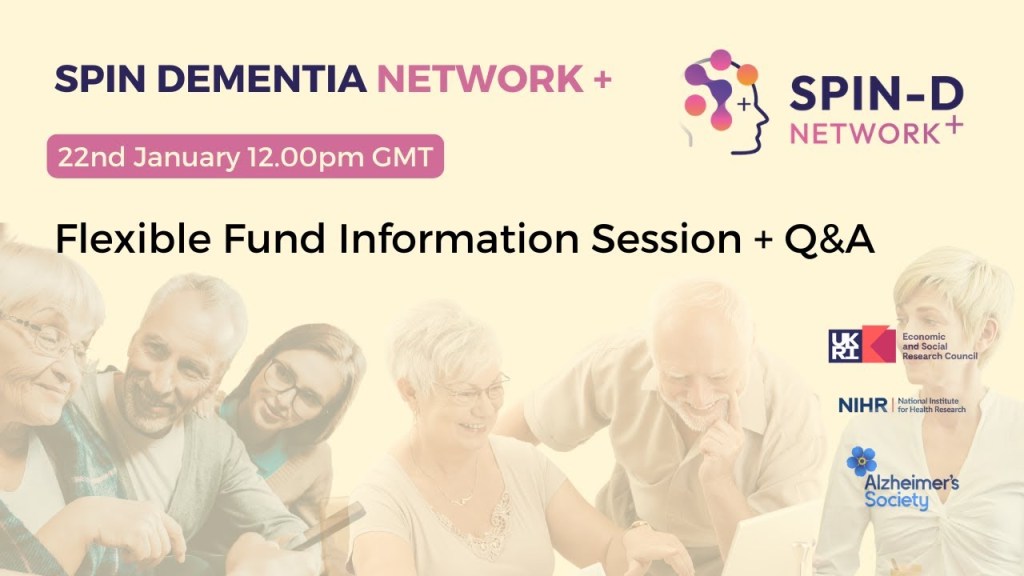
| Call launch | 31 January 2025 | 22 January 2026 |
| Flexible funding webinar | 14 February 2025 (recording here) | 22 January 2026 |
| SPIN-D sandpit | 3 March 2025 | With Interdem Academy, 19 & 20 January 2026 |
| Deadline for applications | 31 March 2025 | 31 March 2026 |
| Successful projects announced | By 30 June 2025 | 31st July 2026 |
| Grants to start | By 1 October 2025 | 1 October 2026 |
| Final project report due | 30 November 2026 | 30 November 2027 |
Funding Calls and Awarding Levels
The second round of Flexible Funding is open from January 2026.
All values based on 80% fEC funding.
| Inclusion in Practice | |
| Maximum amount per application | £4,000 (this is the max that the network will provide, the lead applicant contribution is in addition to this, according to fEC) |
| Minimum amount per application | £400 |
| Proof of Principle | |
| Maximum amount per application | £24,000 (this is the max that the network will provide, the lead applicant contribution is in addition to this, according to fEC) |
| Minimum amount per application | £12,000 |
Guidance Note 1: Inclusion in Practice
Aim
We are looking for projects that facilitate collaboration in the community and with a focus on equity and diversity.
“Small grant and micro-funding schemes are widely used in the voluntary and community sector. These initiatives are thought to offer a wide range of benefits, including engaging diverse and under-resourced groups and stimulating new community activities.”
Crabbe et al 2020
Objectives
- To inform and develop research activity,
- To inform the development of future funding bids,
- To inform and support dissemination of research findings,
- To develop involvement and co-production practice.
Projects should include relevant involvement of charities, industry, government organisations and international organisations as co-applicants, and must ensure they demonstrate how public, patient involvement and engagement is included as part of the leadership team and through the proposed project. Project applications must be led by an early career researcher who is eligible to receive UKRI funding as a Project Lead.
Examples
- running an event with different groups of people to explore new project areas of joint interest;
- carrying out a survey to create research questions;
- knowledge exchange projects (including creative approaches) to allow research findings to be communicated to a different audience.
Guidance Note 2: Proof of Principle Research Project Call
Aim
To pump-prime innovative high-quality, prevention studies that support SPIN-D themes and provide pilot or proof of concept work for external funding applications.
Objectives
- To support collaborative projects that will initiate and/or develop new collaborations across the SPIN-D network,
- To include with co-production partners to ensure that PPIE is embedded within the research,
- To develop outputs that can directly contribute to relevant research within SPIN-D,
- To develop a range of projects that can inform the development of future funding bids.
Projects should include relevant involvement of charities, industry or government, and should demonstrate public and patient involvement and engagement through the proposed project. Project applications must be led by an early career researcher who is eligible to receive UKRI funding as a Project Lead.
Examples
- Secondary research using previously published data,
- Secondary analysis of existing large datasets including large research cohort datasets (e.g. PROTECT, 1947 Birth Cohort; ELSA, Understanding Society, BioBank) and datasets within NHS/service delivery organisations (e.g. primary care data/CPRD, hospital episode statistics), commercial organisations and voluntary and charitable organisations,
- Pilots and proof-of-concept work which may include data from mobile and e-health applications,
- Generation of new evidence including quantitative data (e.g. surveys and questionnaires) and qualitative data (e.g. interviews).
Guidance Note 3: Data Access Fund
The flexible fund includes a dedicated amount of funding to allow access to data sources. At least two projects that are aimed at using the PROTECT database will be supported using this funding across the two planned rounds, and access to other data sources may also be supported.
Applications to the data access fund must meet the same criteria as the other funded projects. An initial step within the competition and approval process will be confirmation of acceptance from the data holder that the project may be accepted and the data provided.
PROTECT Data Access
Launched in 2014, the PROTECT study was created to collect longitudinal data from participants aged 40 and above across the UK to characterise cognitive health in ageing and to identify trajectories and risk factors for early cognitive decline. The study is delivered remotely through an online platform. Data is collected from participants annually; this consists of a well-validated computerised neuropsychological test system and extensive self-report measures that cover demographics, medical history, mental health and lifestyle data, including validated clinical measures. Genetic data is also collected on a rolling basis, with 15,000 samples collected to date. The PROTECT study currently has over 25,000 active participants.
The PROTECT study allows access to study data for secondary analysis by researchers investigating questions outside the scope of the PROTECT team. We also offer cohort access to facilitate recruitment to other studies, and host new studies on the PROTECT platform for researchers to collect data from PROTECT study participants. Charges are implemented to support the data collection infrastructure, time for data set preparation and management, and any development work that may be required. Favourable rates are available for student projects on a case-by-case basis.
Researchers who are interested in more information can contact protect.data@exeter.ac.uk or complete the Microsoft Form (Initial Data Access Form) to begin the request process.
Guidance Note 4: Working with SPIN-D
Funded projects will be included on the SPIN-D website. Successful applicants will work closely with the SPIN-D central team to ensure that the knowledge, findings and outputs from the work are embedded within the work of SPIN-D and contribute to the overall impact.
All recipients of the Network+ funding will be required to provide information for reporting on ResearchFish, according to normal UKRI reporting requirements. Funding to successful applicants will be confirmed by contract, in order to flow down the terms from the original funders (UKRI terms).
Who is eligible to apply?
We can offer funding to those within organisations that are eligible to receive UKRI funding.
Applicants:
- Must be employed, or a PhD student, at a UK academic institution which is eligible to receive UKRI funding,
- Lead applicants must be an early career researcher. This includes those completing their PhD, immediate post doctorate, or transitioning to an independent researcher,
- Must not be a member of the original SPIN Dementia Network + applicant group, or a member of the central leadership and organising team,
- May be involved with multiple proposals but can only lead on one project application. The only exception to this is a combination of a Proof of Principle research project application with a Data access application which may led by the same Principal Investigator, if they are connected with the same overall project.
How will project proposals be evaluated?
All projects will be expected to:
- address the aims within the SPIN-D remit
- take into account priorities identified in public and patient consultations (see Prioritisation document for examples)
- include high quality co-production practices
- involve other people in support of strengthening and building of the network
- demonstrate how the project will generate impact
- be led by an early career researcher working in an appropriate field
- include suitable collaborators to enable engagement with wider stakeholders
- demonstrate how this work will lead to future opportunities for further funding to develop the work
- consider equity, diversity and inclusion, including how to include under-represented groups, such as minority ethnic groups and rural and coastal communities
We encourage applications from across the UK. Where two projects are of equal rank then preference will be given to those projects which lead to greater overall spread of projects across the four nations of the UK.
Funding and UKRI Budget Rules
Full Economic Costing (fEC)
In accordance with SPIN-D funding award rules, flexible funding will be awarded to the recipients on Full Economic Costing (fEC) basis. This is a requirement of the original funders which provided funding on UKRI terms. fEC is the full cost to the eligible institution of undertaking the project and includes all direct and indirect costs. SPIN-D flexible funding will be awarded at 80% fEC, and the recipient research organisation will pay the remaining percentage from their own resources.
Charities, Industry and International Organisations
Charities, industry organisations and international organisations may be part of a funding application as Co-Applicants, rather than as Principal Investigators. They are funded on a different basis, at 100% costs, but excluding overheads. This is in line with UKRI funding principles, as set out here: ESRC research funding guide for the UKRI Funding Service – UKRI.
Further details:
- Applicants based at Universities and Public Service Research Establishments (PSREs) that are eligible to apply as Project Leads or Project Co-leads will be funded under standard fEC rules
- Industry collaborators, Third Sector or Government Body Researchers will be eligible to be paid at 100% direct costs
- International non-academic organisations which are based outside the UK are not eligible.
- The combined costs of international project co-leads from non-OECD (Organisation for Economic Cooperation and Development) DAC (Development Assistance Committee) list countries, plus applicants based in research organisations in India and China, and any project co-leads from UK business, third sector or government organisations on an application cannot be more than 30% of the total fEC
- Allowable costs for industry engaging in economic activity (in compliance with UK Subsidy Control Framework) are salary (excluding superannuation and NI) limited to 1 year, travel and subsistence
- Allowable costs for third sector that does not engage in economic activity (and must provide evidence for this) are salary (including superannuation and NI), travel and subsistence, Other Direct costs
- Allowable costs for Government body are travel and subsistence only
Funding rules are in accordance with UKRI rules which are available in further detail here: ESRC research funding guide for the UKRI Funding Service – UKRI.
FAQs
- Is there a requirement for matched funding?
No, this is not required although we encourage working with other organisations either through project collaborations or other arrangements
- Can applicants be from different organisations?
Yes, this is encouraged, as long as all are eligible for UKRI funding
- Is there a minimum or maximum number of collaborators allowed on each project?
There is a minimum of two applicants and we encourage maximum of 5
- Can the project include industry, charity or government organisations as collaborators?
Yes, they can be co-investigators on the project, but they may not lead projects. Please note the funding for these organisations is different from Universities, and is in accordance with UKRI funding rules
- Are international collaborators allowed to be part of the project?
Yes, this is allowable under UKRI terms. International organisations can be co-investigators but cannot lead projects
- What are the eligibility rules for non-academic and international partners?
Applicants based at Universities and Public Service Research Establishments (PSREs) that are eligible to apply as Project Leads or Project Co-leads will be funded under standard fEC rules
Industry collaborators, Third Sector or Government Body Researchers will be eligible to be paid at 100% direct costs. Further details are provided in Part 4 of the guidance notes and in the UKRI funding rules
- Can one organisation submit more than one proposal with different Principal Investigators?
Yes, however, one Principal Investigator may not lead on more than one proposal within each category of funding, unless in the case of a connected Data Access funding application in connection with a Proof of Principle application
- Can you include tables and figures in the project proposal?
They may be included, however, the text within them should be included as part of overall wordcount
- When can the projects start?
The projects are required to start by the 1st October 2026 after the funding has been awarded (for round 2), unless you receive agreement in writing for a later start
- Where can I include references in connection with my application?
Please include relevant references at the end of the application document. These are not included in the word limits for each section
- Do applicants need ethical committee approval before applying for SPIN-D funding?
We do not expect you to have received ethical approval before application submission but evidence of required ethical approval will be needed before funding can be provided to successful applicants.
- Can applicants who received funding in the 2025 round apply again?
Yes, previous recipients can apply to the 2026 round of funding, and will be considered on a competitive basis alongside other applications.
- Can applicants apply for funding for data access only?
Yes, applicants can apply just for data access, if they do not need additional funding for their project. Other aspects, such as application justification and involvement of different groups and people with lived experience still apply.

 spindementianet.org